 Comparison
DIY Window Film vs Professional Installation: Which Wins?
Last Updated: November 10, 2026
Quick Summary
DIY window film is cheaper upfront, but professional installation usually wins over the life of the film. Once rework, removal of failed film, and the lack of any warranty are counted, the DIY savings can disappear. DIY only makes sense for a single flat, simple pane.
- Compare cost per window, not cost per roll, when weighing DIY against professional work.
- Failed DIY film must be removed first, which adds time and supplies to the job.
- Curved glass, large sliders, and dual-pane or low-E glass are where DIY attempts most often fail.
- Professional installations can carry a factory-backed warranty; DIY work usually has none.
- Check glass compatibility before buying film, because the wrong film can crack the pane.
Table of Contents
- DIY Window Film vs Professional Installation Cost: What You Actually Pay For
- DIY Window Film Pros and Cons: Honest Trade-Offs Before You Start
- Window Film Installation Tools: What a Clean Install Requires
- How Long Does Window Film Installation Take: DIY vs Professional Timelines
- Film Type and Glass Compatibility: Where DIY Goes Wrong
- Residential vs Automotive Window Film: Different Jobs, Different Rules
- When to Book a Professional Window Film Installation
- Frequently Asked Questions
DIY Window Film vs Professional Installation Cost: What You Actually Pay For
The real cost difference between DIY window film vs professional installation comes down to two things: what you spend upfront and what you spend again when the first attempt fails. DIY is cheaper on paper. Professional work is cheaper over the life of the film.
At SolarGlassPros, we have installed decorative, solar, and security films for more than 40 years. The DIY kit price never includes the second roll.
Most cost comparisons stop at the film price. A useful one builds from five line items: film, tools and consumables, labor, removal of failed film, and rework.
Film. Film pricing depends on the film type, the square footage, and the specifications involved. Pricing depends on quantity, dates, and delivery, so request a current quote from SolarGlassPros for exact figures.
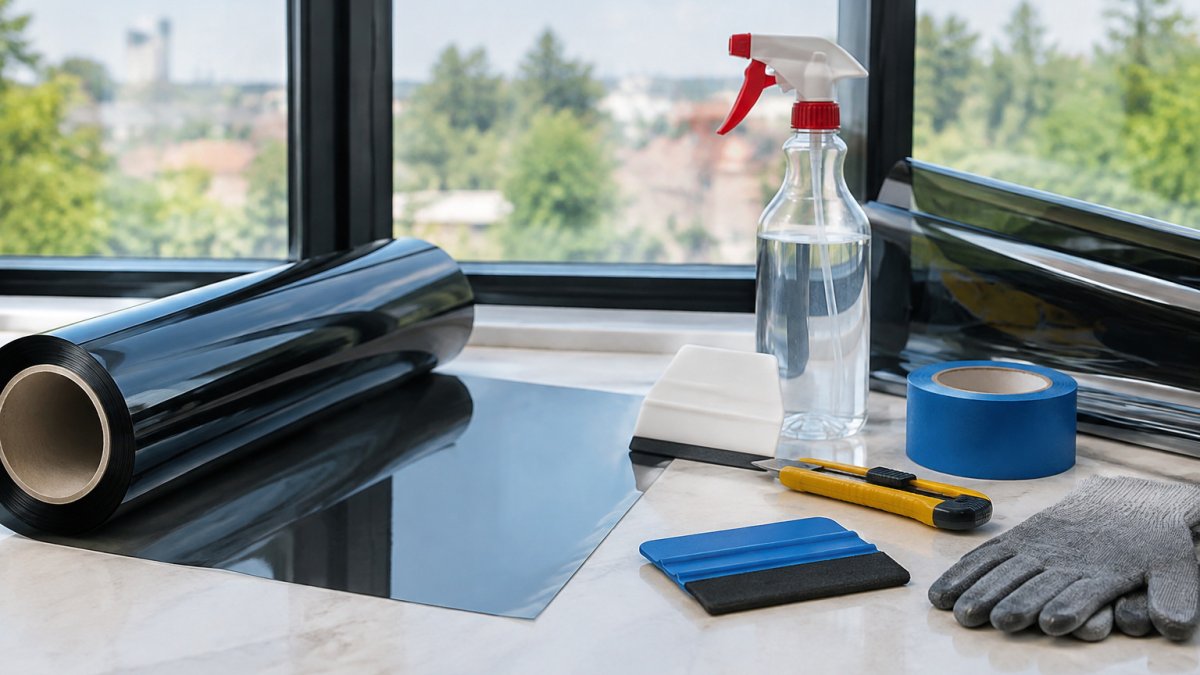
Tools and consumables. The list is short but not free: squeegee, spray bottle, utility knife and fresh blades, measuring tape, plastic scraper, lint-free cloths, and slip solution.
Labor. This is the line DIYers undervalue most.
Removal of failed film. Failed film must come off first, and removal is its own skill: adhesive residue, torn edges, and film bonded to glass all add time.
Rework. Rework decides the comparison. Replacement film, new blades, and a second attempt at the same pane are pure loss on a DIY job.
| Cost Factor | DIY | Professional |
|---|---|---|
| Film | Retail per roll, often overbought | Trade pricing, bundled into service |
| Tools and consumables | You buy and keep them | Included |
| Labor | Your time, often underestimated | Priced into the job |
| Removal of failed film | Your labor plus supplies | Built into redo |
| Rework risk | You absorb it | Covered by the installer |
| Warranty | Usually none | Factory-backed |
| Lifespan | Shorter if applied poorly | As intended by the maker |
For one small, flat pane, DIY is defensible. For a full home or a storefront, rework cost can erase the savings. Compare on cost per window rather than sticker price.
DIY Window Film Pros and Cons: Honest Trade-Offs Before You Start
DIY is genuinely the lower-cost route for straightforward, flat glass, and the route most likely to end in bubbles, creases, and peeling edges.
Pros
- Lowest upfront spend, since you pay only for materials
- Full control over timing, no scheduling around an installer
- Fine for a single pane or a rental you will not keep
Cons
- Dust contamination ruins adhesion, and a home is full of dust
- Curved windows and large sliding doors are unforgiving
- No warranty on your own work, so a failed film is a full loss
Madico, a film manufacturer, states that professional installation looks better, lasts longer, and performs as intended. That is a manufacturer's view rather than a controlled study.
Watch out: buying film online without checking glass compatibility is the most common DIY mistake, and it can crack the pane rather than just waste the film.
Window Film Installation Tools: What a Clean Install Requires
A clean install depends on tools as much as technique. Professional crews carry a full kit because each tool solves one specific failure mode.
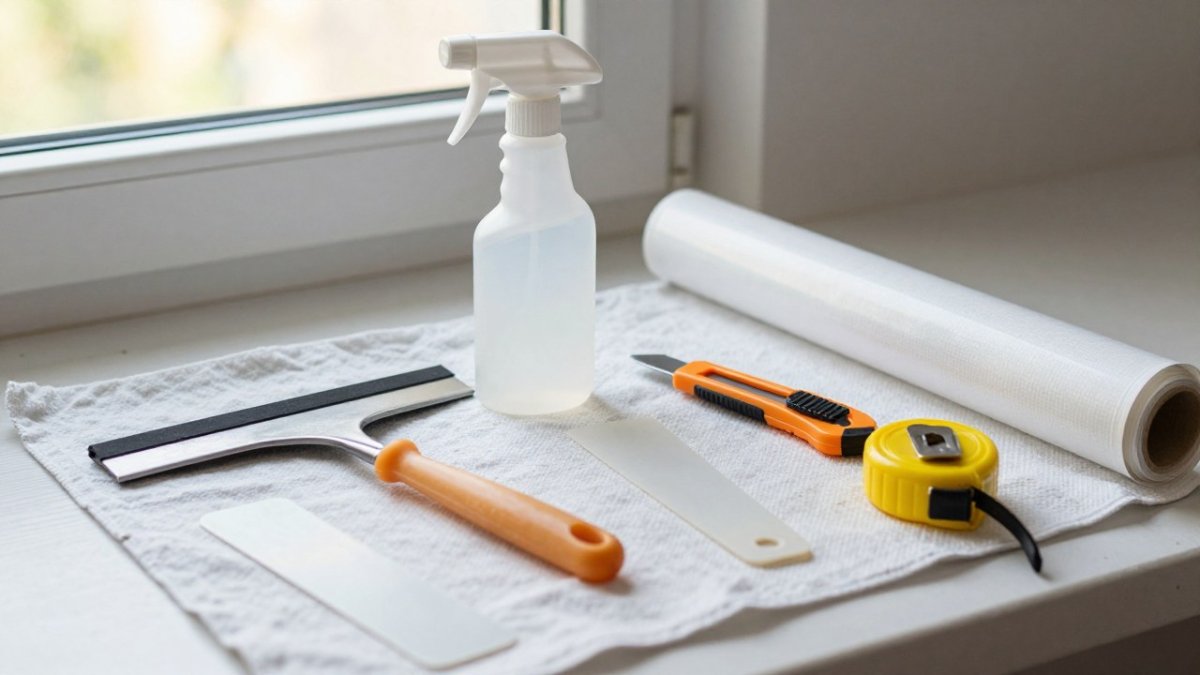
The essential window film installation tools are:
- Squeegee with a firm, unmarked edge to push solution and air out evenly
- Spray bottle for the slip solution that lets film float into position
- Utility knife with a fresh blade for clean trimming, changed often
- Measuring tape to cut oversize, never undersize
- Plastic scraper for glass cleaning before anything touches the pane
- Lint-free cloths to avoid leaving fibers under the film
What most guides miss is blade discipline. A dull blade drags and tears the film edge, and that tear is where peeling starts months later. Professionals change blades mid-job. Most DIYers use one.
How Long Does Window Film Installation Take: DIY vs Professional Timelines
Professionals finish faster because they have done the same pane a thousand times. A first-time DIYer should expect roughly three to four times the labor.
How long window film installation takes depends on glass count and complexity. A single flat residential pane is quick work for a trained hand. A curved window, a large slider, or automotive glass with defroster lines adds time for anyone.
- One flat pane: under an hour for a pro, a few hours for a beginner
- A full room of windows: a half day for a crew, a full weekend for DIY
- Automotive glass: longer for both, because curves and heat-shrinking demand practice
The hidden time cost is preparation. Cleaning glass properly takes longer than applying the film, and skipping it is why so many DIY jobs fail.
Film Type and Glass Compatibility: Where DIY Goes Wrong
Film type decides whether a job is DIY-friendly at all. Some films are forgiving. Others punish inexperience and can damage the glass itself.
Flat, dyed, or basic solar film on standard annealed glass is the most forgiving combination. The International Window Film Association recommends checking glass and film compatibility before installation, because the wrong film on the wrong pane can cause thermal stress and cracked glass.
That is the failure nobody warns you about. Solar film absorbs or reflects part of the sun's energy, so the glass behind it runs hotter than bare glass would.
Compatibility is not only about heat. Film construction has to match the glazing: a film designed for single-pane glass may not suit an insulating unit, and a security film needs an attachment system at the frame to do its job.
How to compare film specifications. Vague claims like "blocks heat" are not comparable across products. These are the metrics that are:
- Visible light transmission (VLT): the percentage of visible light the film lets through. Lower VLT means darker glass and more privacy; higher VLT means more daylight. VLT is also the number state tint laws regulate on vehicle glass.
- Total solar energy rejected (TSER): the share of the sun's total energy, visible, infrared, and ultraviolet, the film keeps out. This is the number that tracks heat rejection.
- UV rejection: the share of ultraviolet radiation blocked. Most quality films advertise high UV rejection, and it is the spec that matters for fading and interior protection.
- Glare reduction: how much visible light the film removes, expressed as a percentage. It is derived from VLT and is the spec that matters for screens and workspaces.
Read all four together. A film with high TSER and low VLT will run dark; a film with high VLT and modest TSER will stay bright but reject less heat. The right balance depends on the room, the glass, and the goal, exactly the judgment a first-time buyer is least equipped to make from a product page.
Automotive film adds its own rules. Curved glass needs heat-shrinking, and defroster lines trap air. A first attempt usually shows creases and silvered edges within weeks.
Our view: if your glass is dual-pane, low-E, or curved, book the professional. The film is only as good as its match to the glass.
Watch out: buying film online without checking glass compatibility is the most common DIY mistake, and it can crack the pane rather than just waste the film.
Residential vs Automotive Window Film: Different Jobs, Different Rules
Residential and automotive window film are not the same job with different sizes. They differ in film, technique, and regulation.
Residential windows are mostly flat, installed vertically, and chosen for heat rejection, glare reduction, UV protection, privacy, and energy efficiency. Automotive glass is curved, often has defroster lines, and is chosen for heat and glare inside a small cabin. Many states limit visible light transmission on car windows, while home windows generally face fewer limits.
| Factor | Residential | Automotive |
|---|---|---|
| Glass shape | Mostly flat | Curved |
| Main goals | Heat, UV, privacy, energy | Heat, glare, privacy |
| Difficulty | Moderate | Higher |
| Rules | Few limits | State VLT limits |
A DIYer who has done home windows will still struggle with a car's rear glass. The skills do not transfer cleanly.
When to Book a Professional Window Film Installation
Book a professional when the glass is complex, the film is high-performance, or the result has to last. That covers most homes and nearly every commercial job.
Professional craftsmanship matters most on curved windows, large sliding doors, security film, and any low-E or dual-pane glass. A lifetime factory warranty is the real long-term value of the film. If a film fails in five years, a warranty-backed install means repair or replacement rather than a full redo.
At SolarGlassPros, films carry a lifetime factory warranty, and our films can reduce solar heat by up to 90% while protecting interiors from UV damage. We are family-owned, we specialize exclusively in window tinting, and we have over 40 years of experience.
For a free quote on your windows, start with an assessment of your glass and goals.
The honest answer to DIY window film vs professional installation is that DIY saves money only when nothing goes wrong, and something usually does on anything but flat, simple glass. If your windows are curved, dual-pane, or part of a business you cannot afford to disrupt, get the installation done right the first time.
Frequently Asked Questions
Is DIY window tint worth it?
It depends on the film type and the window. A DIY kit saves on labor but requires buying materials, and results vary with your technique. Flat, small residential windows are the most forgiving. Curved automotive glass, large sliding doors, and security or decorative films are much harder to get right, and mistakes show up as air bubbles, creases, or peeling edges. Weigh the material cost against the risk of rework before you commit.
Can I install window film myself?
Yes, and many homeowners do. A basic install needs a squeegee, spray solution, measuring tape, utility knife, and a clean workspace. The hard parts are surface preparation and cutting accurately. Dust contamination under the film is the most common cause of visible defects, so clean the glass and the surrounding area thoroughly. If your windows are curved or oversized, professional installation is the safer route.
Can DIY window film cause bubbles or peeling?
It can. Air bubbles, creases, and peeling edges are the classic DIY failure points, and they usually trace back to trapped dust, uneven squeegee pressure, or film cut too short at the edges. Manufacturer guidance notes that professional installation looks better, lasts longer, and performs as intended. A warranty-backed professional job also gives you recourse if the film fails, which a self-installed film typically does not.
How much does professional window film installation cost?
Pricing depends on film type, square footage, window complexity, and removal of any old film, so there is no single number. Pricing depends on quantity, dates, and delivery, so request a current quote from SolarGlassPros for exact figures. Request a quote with the film specification and warranty terms spelled out so you can compare like for like rather than headline prices.